Garage Door Won't Open or Close? The Common Causes Worth Checking First
QUICK ANSWER: When a garage door won't open or close, the cause is usually one of a handful of things: a blocked or misaligned safety sensor, a dead remote or opener with no power, a broken spring that makes the door too heavy to lift, a door that has slipped off its tracks, or opener force and travel settings that have drifted. A few of these are safe to check yourself, like sensor alignment and remote batteries. Springs, cables, and off-track doors are not. Those hold enough stored tension to cause serious injury and belong to a trained technician.
You hit the button, the motor hums, and the door just sits there. Or maybe it starts down, thinks about it for a second, then rolls right back up like it changed its mind. Either way, your car's trapped and you've got somewhere to be. Before you start yanking on anything, it helps to know what's actually going wrong, because the fix for a dead remote battery looks nothing like the fix for a snapped spring.
Most of the time the problem is smaller than it feels. We've pulled up to Apopka and Orlando driveways expecting a major repair and found a spider web across a sensor lens. Other times a "quiet" door turns out to have a broken spring hiding above it. Knowing the difference keeps you safe and saves you a wasted afternoon.
Start Here: Is It the Door, or the Opener?
This one test tells you more than anything else. Find the red cord hanging from the opener rail and pull it. That disconnects the door from the motor so you can work the door by hand.
Now lift the door yourself, slowly. A healthy door should glide up and mostly stay put wherever you leave it, held in balance by its springs. If it feels light and smooth, the door is fine and your trouble lives in the opener. If it feels like you're deadlifting a refrigerator, or it slams back down the second you let go, the door itself is out of balance. That points straight at the springs, and that's where you stop and call someone.
One caution before you pull the cord. Only do this with the door fully closed. If a spring is already broken and you release the trolley with the door partway up, the door can drop. Feet and fingers lose that fight every time.
The Safety Sensors Trip People Up More Than Anything
If your door opens fine but refuses to close, or closes a foot and reverses, look down low first. Every modern door has two little photo-eye sensors mounted a few inches off the floor, one on each side, staring across the opening at each other. Break that invisible beam and the door won't close. That's the whole point of them, so a kid or a pet never gets pinned.
The catch is they trip over almost nothing. A rake leaned against the wall. A recycling bin nudged into the beam. A film of dust or a spiderweb on the lens. Central Florida gives sensors a rough time, too, since pollen and fine grit blow into open garages and settle on everything.
Check for a blockage first. Clear the floor along the door's path and look for anything crossing between the two eyes. Then check the lenses. Wipe each one with a soft dry cloth. Last, check the alignment. The sensors have small indicator lights. When both glow steady, they're aimed at each other correctly. If one blinks or goes dark, it's been bumped out of line, and you can loosen the wing nut, nudge it until the light holds steady, and tighten it back down. Do this by hand only. There's no tension and no danger here, just a fussy little eye that wants to see its partner.
TIP: Test your sensors once a season. Start the door closing and wave a broom handle through the beam near the floor. The door should stop and reverse right away. If it keeps going, stop using the opener until the sensors are fixed, because that reversing feature is what protects anyone standing underneath.
When the Opener Is the One Acting Up
Say you did the manual test and the door glides fine by hand. Now the opener's on the hook. Start with the boring stuff, because the boring stuff is usually right.
No power at all? Check that the opener is plugged in and that the outlet has power. A tripped breaker in a hot, humid garage is more common than people think, especially after a summer storm rolls through Central Florida and the grid hiccups.
Remote does nothing but the wall button works? That's almost always a dead remote battery, and sometimes the remote just needs to be reprogrammed to the opener.
Nothing responds? Some openers have a vacation lock switch on the wall panel that quietly shuts the remotes out.
Then there are the settings that drift over time. Openers have force limits that control how hard the motor pushes, and travel limits that tell it how far to move. When the force is set too low, the opener senses the resistance of a normal door, decides it hit something, and stops or reverses to be safe. When travel limits are off, the door stops short of the floor or the top. These adjustments exist for good reason, and a small turn of the wrong screw can make a working door behave like a broken one. If the basics check out and the door still won't cooperate, that's a diagnosis better left to a tech who can read the opener's blinking diagnostic light and set the limits correctly.
Broken Springs and Cables: The Part You Never Touch
Here's the one that sends people to the emergency room. The springs above your garage door, whether it's a torsion spring on a bar over the opening or extension springs running along the tracks, do the real lifting. Your opener barely works; the springs carry the weight. When one snaps, the door turns into a few hundred pounds of dead steel the opener can't budge.
You'll usually know. A breaking spring makes a bang like a firecracker, loud enough to hear from inside the house. Look at the spring above the door and you might see a clean gap where it split, the coil now sitting in two pieces. The cables that run down the sides can fray or jump their drums, too, and once they do the door hangs crooked.
WARNING: Never try to replace or adjust a garage door spring or cable yourself. These parts stay under extreme tension even when the door is sitting still, and a slip can launch a tool or a coil with enough force to break bones or worse. There are no shortcuts and no safe DIY version of this repair. Call a trained technician, every time.
Florida's climate speeds this failure along. Salt air drifting in from the coast and months of thick humidity eat at bare metal, and rust pits the spring wire and stiffens the cables until they give out early. A spring that might last years in a dry climate can wear out faster here. That's not a reason to panic, just a reason to have the hardware looked at before it fails on a Monday morning.
Off-Track Doors and Bent Rails
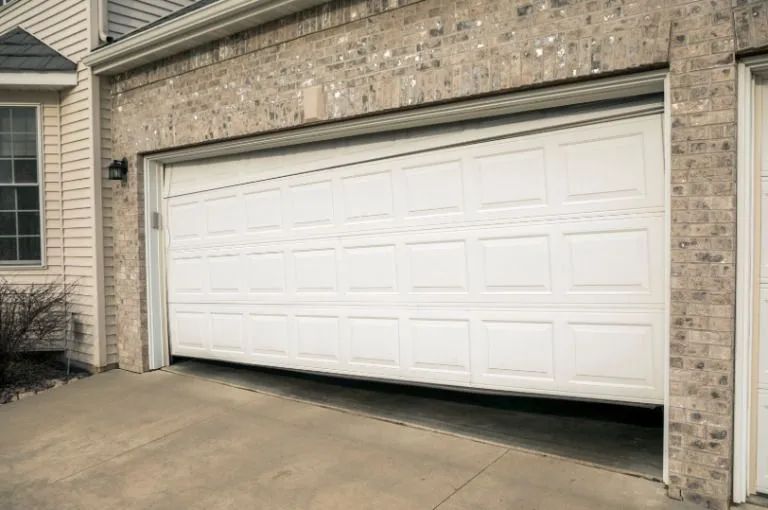
A door that's jumped its track looks wrong the moment you see it. It sits crooked, one side higher than the other, with the rollers popped out of the metal channel and a gap opening between the panels and the frame. Sometimes it jams solid. Sometimes it sags and looks ready to fall.
Do not run the opener again once you spot this. Forcing a door that's off its rails bends panels, snaps rollers, and can bring the whole thing down. The tracks themselves can bend too, from a bump with a car bumper or a stray ladder, and a kinked rail will hang the rollers up every time they reach the damage. Minor track dents sometimes tap back into shape, but a door that's fully off-track is heavy and unpredictable. That's a stop-and-call situation, not a wrestle-it-back-in-place one.
Frequently Asked Questions
Why does my garage door open but not close?
Nine times out of ten it's the safety sensors near the floor. Something blocks the beam, a lens is dirty, or one sensor's bumped out of alignment. Clear the floor, wipe both lenses, and check that the indicator lights glow steady and hold.
Can I open my garage door if the spring is broken?
You can lift it by hand after pulling the red release cord, but it'll be dangerously heavy and can drop fast, so get help and keep hands clear. Better to leave it down and call a technician instead.
Why does my garage door reverse before it hits the ground?
Usually one of two things: the sensors see an obstruction, real or imagined, or the opener's force and travel limits have drifted. Check the sensors and floor first. If those are clear, the settings need a tech's adjustment.
Is it safe to adjust my garage door springs myself?
No. Springs and cables hold extreme tension at all times, even with the door closed and still. A slip can send a coil or tool flying with enough force to cause serious injury. Always bring in a trained professional.
Why does my garage door stick or move slowly in the summer?
Central Florida heat and humidity thin out lubricant on rollers and hinges and leave sticky residue that adds friction. Panels can swell too. Cleaning the tracks and relubricating usually helps; persistent sticking points to worn hardware.
How often should I have my garage door serviced in Florida?
Once a year suits most homes here, more often near the coast where salt air corrodes metal faster. A yearly inspection catches rusting springs and frayed cables early. Between visits, a quick seasonal wipe-down and lubrication handles the rest.
Before You Reach for the Button Again
A door that won't budge feels like a crisis, but most of the time it's telling you something small and fixable. Look low at the sensors, check the remote and the breaker, and pull the release cord to see whether the door or the opener is really at fault. Just draw the line at the springs, the cables, and anything that's slipped off its tracks. Those parts carry too much stored force to gamble with, and a door that's cared for a little each season is one you rarely have to think about at all.
When it's time for a straight diagnosis, Hicks Garage Doors, LLC
brings 20+ years of
experience handling springs, openers, and off-track doors for homeowners across Apopka & Orlando, Florida. That kind of hands-on history means a tech who's seen the same rattle, the same stuck track, and the same worn cable more times than they can count, and who knows within a few minutes whether it's a quick fix or something that needs real attention. The tension-loaded repairs get done safely instead of guessed at, and the smaller stuff gets caught before it turns into a bigger bill.